
When babies with biliary atresia undergo the Kasai procedure, parents naturally wonder how long their native liver will last. In Matthew’s case, it’s been 35 years! His mum, Liz, tells his story.
Matt did not have his Kasai until he was 13 and a half weeks old. It was November 1990 and it was sadly fairly common back then for biliary atresia not to be picked up early, despite my going to the health centre and insisting to a variety of doctors that our baby really wasn’t well and being told “Oh I’m sure he only has breast fed jaundice.”
We were just really lucky that on one of the days I took him into our health centre, there was a locum doctor on duty, who took one look at him and said “I think you need to get your baby into hospital”. He then went from the old Norfolk and Norwich Hospital, in an emergency ambulance to King’s. The rest is history.
Matt just before his Kasai surgery

Matt’s Kasai was done by Mr Howard at Kings when he was 95 days old. My husband, Rob and I have since been told since by Dr Colin Ball at Kings that he has used Matt’s notes in lectures a number of times as an example of an exception, a child who has been lucky enough to thrive after such a late stage Kasai.
When Matt was very small, he had a range of medications and it was frequently very difficult for us to get him to accept taking these meds. When he was three and a half, we had an appointment with Dr Ball and his team who saw what a battle we were having and suggested he try life without any supporting meds. He did well, and so he hasn’t taken any more medication since that time although he continues to attend hospital appointments.
Because Matt seemed to thrive after his Kasai and he was one of three children, as he was growing up, we generally took the view that we would encourage him to throw himself into life. He was cleared to play rugby at school once he was 13, and although he had to be careful not to take any big hits and didn’t play in super-competitive matches, he joined in with absolutely everything. Perhaps because we live near a river and rowing is ‘big’ here, he discovered that he really enjoyed it. He then ended up as captain of his rowing team at sixth form and university.
Matt (second from the right) excelled at rowing

Not everything went smoothly, however. When Matt was about nine years old, we moved to a different area and he developed ‘school phobia’ at that time. He then recovered OK, but when we returned to Cambridge when he was 11 years old, he then developed it again, and was a refuser for a year and a half.
Although we couldn’t entirely prove this, I was always firmly of the belief that his refusal and anxiety was rooted in his early years’ experience. There is some evidence that children who have had early trauma and numerous hospital admissions can find school overwhelming.
Fortunately, Matt was back in school by the time he was 12 or 13 and then settled down well, going on to take A levels and read History at Kent University. He did well, achieving a high 2:1 in his degree although basically, he is bright and sociable, and loved his rowing at that stage of his life.
Matt was treated at Kings until he was transferred to the adult services at Addenbrookes which I think was a bit of a shock. Addenbrookes are a great hospital, but the adult liver dept is nothing like the cosy, warmth of the supportive Kings Children’s liver dept that Matt and all of us had been used to.
Of course we’re not involved in Matt’s medical care now but he keeps us in the loop that all is well and he’s doing OK. He married Amy (a trainee anaesthetist) in 2021 and we enjoy meeting them for lunch with the rest of the family and going for country walks with them. This gives Robert and I particular amusement because we well recall how as a child, Matt was defiantly against being dragged out with his sisters on family walks, and on one or two occasions memorably lay down in the middle of a field, refusing to walk another step!
When Matt had his Kasai operation at 13 and a half weeks old, we were made very aware that this was extremely late to operate, and the chances of his survival were very slim (20%). The fact that we can meet up with Matt, as an adult, with his wife Amy, and do fun things together is for us a wonderful, miraculous joy.
Matt married Amy in July 2021

Matt’s story
I don’t feel that my liver condition impacted on my life hugely when I was growing up. Other than the regular hospital visits, my parents did a very good job of treating me fairly normally. I was always aware of it, as I was unable to do some sports, predominantly contact sports when I was young. However, I was cleared to do these later, which made me feel a bit more normal. You are aware of getting hit and being totally winded for a few minutes where others would just jog on.
There were definitely moments of frustration, for example having to speak to clinic to clear doing certain things and then at times be told, ‘we’ll review in six months or a year and see where we are then.’ I’d hope that now it’s perhaps easier for young people to discuss these annoyances as they have CLDF’s network to share their experiences. I think it’s inevitable that your liver condition will frustrate you at times and make you feel isolated, as everyone wants to be “normal” and not feel like they are being excluded unnecessarily when they are growing up.
As a child, I would explain my scar as a shark bite and didn’t really tell people about my liver condition until I was about 13. When I did tell people they did get it to a degree, but at the time my understanding of my condition was still quite vague so I wasn’t able to get it across very well; I think it’s hard to comprehend properly at that age anyway. As a teenager, I didn’t ever meet people my own age who were going through similar things and I’m glad to see that young people do have that opportunity and new networks now.
My health is still very good, I live a normal life which isn’t really affected by the biliary atresia on a day to day basis. I have six monthly clinic appointments for monitoring, and have a MRI contrast scan ahead of these appointments. Alongside this I now have to have three yearly endoscopies – not pleasant but haven’t shown any changes and seem to be part of a more enhanced monitoring as I get slightly older (I’m now 35). I take the positives from this – none of us know what is going to happen in the future and I know that to be living a very normal and unburdened life is certainly a huge blessing.
And life is going pretty well. I have just started a new job as a project manager with a tech company in Cambridge, so a bit exhausted but comes with the new job territory. When I’m not working I like to play my drums, I’ve got an electric kit so its not overly noisy, I also enjoy cooking and love to try out new dishes. Amy and I enjoy walking and love to get away to the hills or the coast and we also like to get abroad. We went ski-ing at the start of the year and have just got back from Iceland. Holidays tend to be quite active ones either away walking and exploring, skiing, diving or travelling about places and packing in as much as we can to get to know a new place.
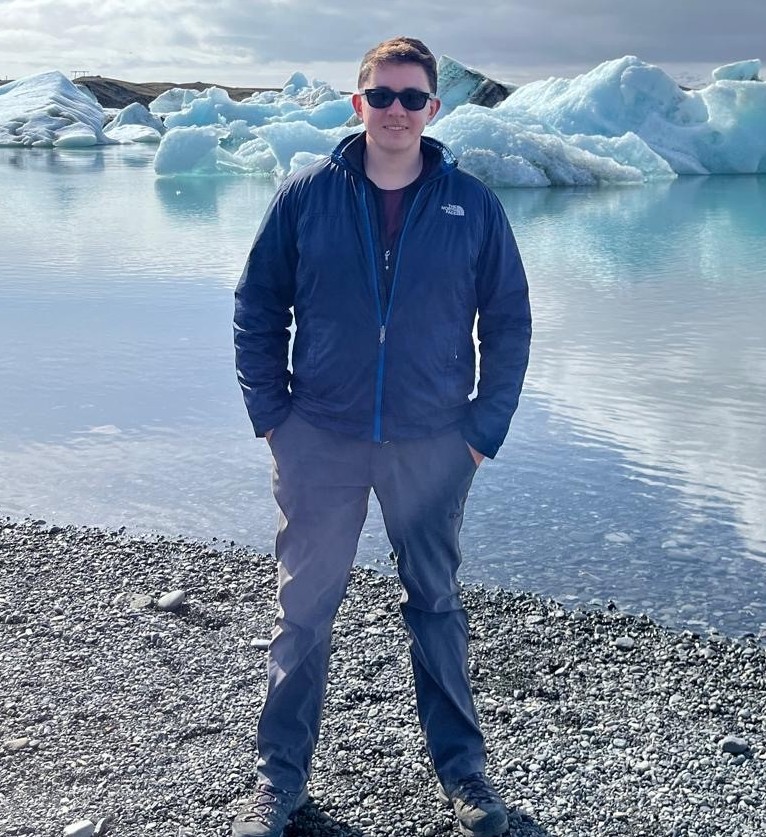
Matt on his recent trip to Iceland
To young people currently growing up with a liver disease, I would say don’t be too hard on yourself if you slip up and do things that maybe you shouldn’t. No one is perfect, but consider how your choices may impact in 15 or 20 years time and really try and live your life.
I’d also say that if you have concerns about things, talk. I’d hope that with the CLDF networks now available it is easier to share experiences and make that easier, but certainly, for me I kept a lot inside for a long time and it was great in my mid-20s to have some therapy and get a lot of it out. I’d say accept that you’re different, but that’s cool. It’s you, and it can be an interesting conversation starter – it certainly was for me with my, now wife, whilst we were dating!
Final thing would be, talk to your parents and find out more when you want to know things if you don’t already. They will, obviously, be able to fill in a lot of gaps for you, and be kind. It probably took a big toll on them too seeing you unwell and that they will likely always worry about you – my mum certainly still does – but that’s natural. You need to carve your path and build your own road of living with your condition and make it something which works for you.

